Methodology

How a bore
actually happens.

A look at the six-phase process behind every Underground Connections horizontal directional drilling project — from desktop study to closeout documentation.

An Engineered Discipline

One pipe. Zero open trench.

A horizontal directional drill installs utilities along a curved underground path — entering at one pit, exiting at another, leaving everything in between untouched. But the bore itself is one act in a longer sequence: each phase below carries its own equipment, its own risks, and its own success criteria.

Grade Level Surface activity continues uninterrupted Roadway · no closure required Entry Pit Drill begins here Exit Pit Pipe surfaces here Depth Per engineered design Bore Length · Entry to Exit Engineered Bore Path Installed Product Pipe
The Six Phases

From plan to as-built.

Phase 01 — Pre-Construction

Planning & Design

Every successful bore starts on paper. Our pre-construction team performs a desktop study, walks the site, reviews subsurface utility records and geotechnical data, and develops a bore plan that accounts for grade, depth, soil conditions, existing infrastructure, and surface activity. We coordinate with utility owners and right-of-way authorities before the drill ever arrives.

Activities

Desktop study, geotechnical review, route design, permit and ROW coordination.

Tools

GIS & bore-path design software, utility owner records, geotechnical reports.

Deliverable

Permitted, engineered bore plan with risk register and contingency procedures.

Phase 02 — Mobilization

Site Setup & Utility Verification

Before the drill turns, every existing utility on the route is identified and physically verified. We follow OSHA-compliant locating protocols, perform vacuum-excavation potholing at every critical crossing, and stake the bore path. Equipment is staged, traffic control is deployed, and a documented pre-task safety brief is held with the crew.

Activities

Public & private locates, ground-penetrating radar, vacuum potholing, traffic control, pre-task plan.

Equipment

Vacuum excavator, GPR units, electromagnetic locators, MOT signage.

Deliverable

Verified subsurface conditions and an executed daily safety plan signed by the crew.

Phase 03 — Drilling

Pilot Bore

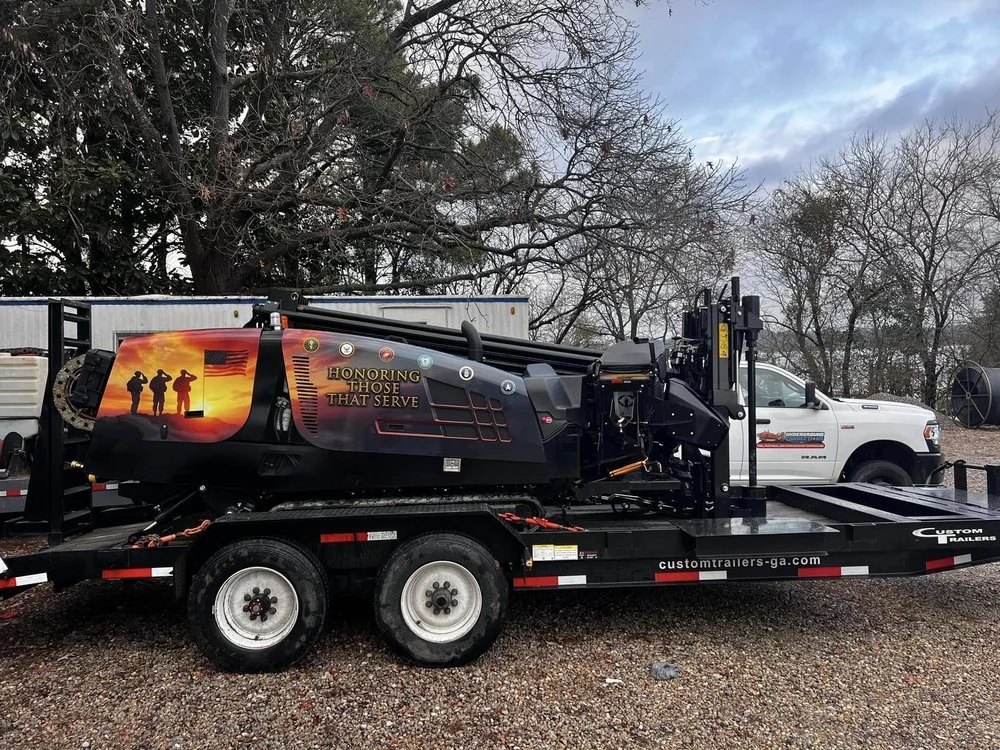
The pilot bore establishes the route. Our operator drives the drill head along the engineered profile, steering with a downhole transmitter while a tracker maintains real-time depth and bearing readings on the surface. Drilling fluid — a controlled bentonite mix — is circulated to stabilize the borehole and remove cuttings.

Activities

Pilot drilling, real-time tracking, drilling-fluid management, deviation logging.

Equipment

HDD rig, downhole tooling, walkover or wireline tracking, mud-mixing system.

Deliverable

A bored profile that matches design — verified, logged, and ready for upsizing.

Phase 04 — Drilling

Reaming

The pilot bore is enlarged to the diameter required for the product pipe. We select reamer type and pass count based on soil conditions, pipe diameter, and bore length — maintaining fluid pressures within safe limits to prevent inadvertent surface returns.

Activities

Sequential reaming, fluid-pressure monitoring, hole-stability assessment.

Equipment

Hole openers, fly-cutters, mud motor (where required), pressure sensors.

Deliverable

A stable, properly sized borehole ready for product pullback.

Phase 05 — Installation

Pipe Pullback

The product pipe is fused, hydro-tested, and staged ahead of pullback. With a swivel between the reamer and pipe to relieve torque, the pipe is pulled through the bore in a controlled, continuous operation. Tension and torque are monitored throughout so the pipe is installed within manufacturer specifications.

Activities

Pipe fusion, pullback execution, real-time tension monitoring, swivel management.

Equipment

HDPE or steel pipe, fusion machine, pull head, swivel, hydraulic monitoring.

Deliverable

Product pipe installed to design depth and grade without damage or overstress.

Phase 06 — Closeout

Restoration, Testing & Closeout

With the pipe in place, we perform any final pressure or continuity testing, restore every disturbed surface to original or better condition, and deliver complete as-built documentation — coordinates, depth profile, deviation report — to the asset owner.

Activities

Pressure or continuity testing, surface restoration, as-built drafting, punch-list closeout.

Equipment

Restoration crews, GPS receivers, drafting tools, QA inspection.

Deliverable

A tested, fully restored installation with complete as-built and turnover documentation.

Apply It to Your Project

Have a bore in mind? Let's plan it.

Tell us about your route, soil, and timeline. We'll start with a feasibility review and a clear scope of work.